
| |||
| Home | Contact | Lodging | Alamo Springs Volunteer Fire Department |
  If you learn about a burglary or theft, or have a tip, call it in to the CRIME STOPPERS anonymous line: 800-384-LEAD (5323)
|
The Alamo Springs Volunteer Fire Department 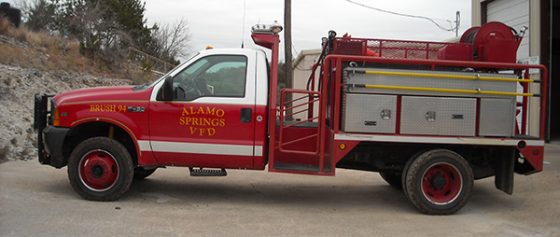 March 2019: This is now a 501(c)(3) organization. Donations are tax deductible. Hello Neighbors, near and far. It's been quite a while since we went out an update on our activities. We've made a few changes and additions to help us do a better job of serving the community. There were two major projects: The first was to acquire a more capable brush truck and take two aging trucks out of service. We retired "Old Yeller", the 1985 Ford F350, which we purchased in 1999. It was showing its age and wasn't reliable, which is bad trait for a fire truck. We also retired the ex-military "Deuce and a half" which we'd had since 2009. It was really old (a 1971 model) and had some problems not worth the effort and expense to fix. It had been on loan from the Texas Forest Service, so we turned it back over to them. Since a new truck was not an option, we were fortunate to find a used, but well maintained, 4-wheel drive, F450 with 400 gallons of water, foam system and the usual assortment of equipment. We expect many years of service from it. We do have a standing grant request with the Forest Service for a new brush truck. We'll just have to wait to see if our number is ever called. The second major project was to increase the amount of water available to fire trucks. As you know, water is scarce in this area most of the time. We installed 20,000 gallons of water storage in 2 locations in our area of responsibility. Each site consists of 8-2500 gallon poly tanks plumbed together. One is on Walnut Road about a mile south of Deer. The second is on Grape Creek Road about 4 miles west of Old Number 9. They have the proper fittings for our trucks and are available to any department assisting us with a fire. We ask for your help in a few areas. If every landowner does them, we will be able to provide better service for all. First: Post street numbers on the road in front of your driveway on both vacant lots and residences. Fires are usually easy to spot but not always, especially if there is a steep canyon involved. Since half of our calls are EMS related, no numbers complicate our finding the person in need; it lengthens our response time. So, please, post those numbers prominently and make them large enough to be readily seen. Kendall County will make you a reflective number placard for $15. You can go to their web site, www.co.kendall.tx.us and find the order form. Second: Please keep your driveway cleared of overhanging trees and foliage. A year or so ago, the responders had to go back to the station to get a chain saw to trim trees so the EMS ambulance could get closer to a patient needing medical care. When tree limbs and emergency lights meet, the limbs win. It puts a valuable asset of commission. Third: A recurring problem is that of controlled burns of trash, brush piles, etc. We ask that you contact the Kendall County dispatch office and notify them of your intentions. Their toll free number is 1 877 249-8645. You'll be asked for your name, location of the burn and a call back number. This notification is important because if someone calls 911 to report a fire, dispatch will already know that there is a controlled burn in the area and make us aware. Additionally, you need to know that any of this type of fire needs to be out at dark. It is illegal to burn at night. We are recruiting. We meet the first Tuesday of every month at 7 PM. Please come by and see what we do. Finally, we remind that we are a tax deductible 501 (c)(3) non-profit organization and ask that you support us, and appreciate any donation to help us improve this department. Donations assist us in qualifying for grants by showing that we have the support of our community and friends. People often ask why we don't have fund raisers. our answer is that our manning is too small to organize and run one. They are extremely labor intensive and would detract from the limited tijme we have for training and maintenance. On behalf of all our volunteers, thank you! Sincerely, The Alarmo Springs Volunteer Fire Department A tax exempt 501C4 organization |
| |||||||||||